Belt drives, gearboxes, and why your next e-bike might not have a derailleur
Gates belts, Rohloff and enviolo hubs, plain-English trade-offs, and the maintenance math from a shop that services all of them daily.
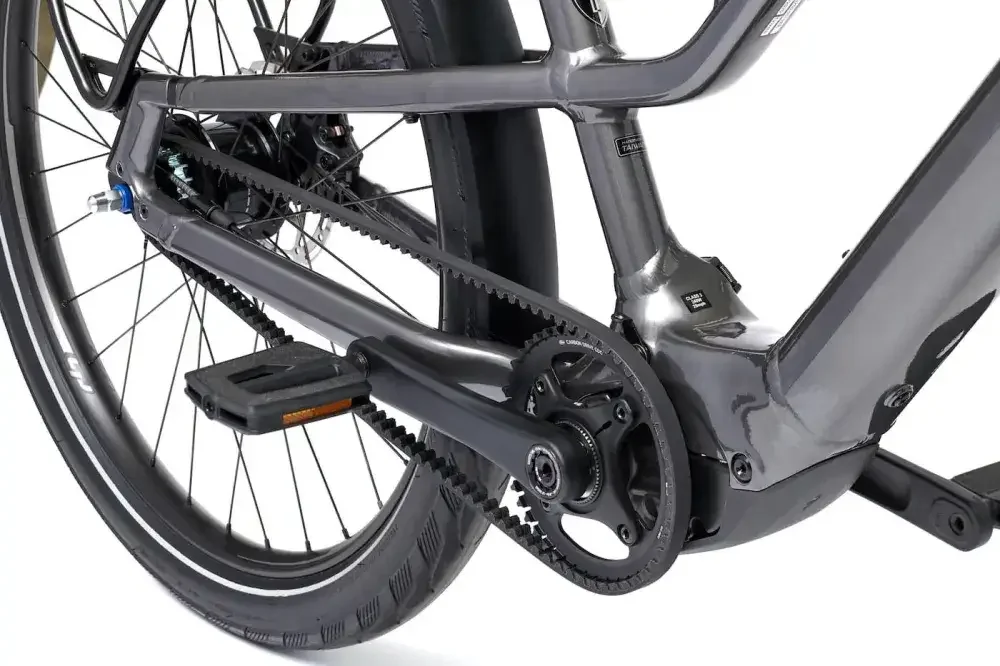
Walk our floor in Brooklyn and count drivetrains. On the commuter wall and the cargo row, a growing share of the bikes have no derailleur, no cassette, and no chain. A smooth black belt runs from the crank to a sealed hub in the rear wheel, and that's the whole system.
For the way most people actually use an e-bike (daily, loaded, parked outside, ridden in weather), the century-old chain-and-derailleur setup is the high-maintenance option. Here's the whole picture, including when the old way is still the right way.
Two jobs you've probably never separated
A drivetrain does two jobs, and you can mix the tech for each:
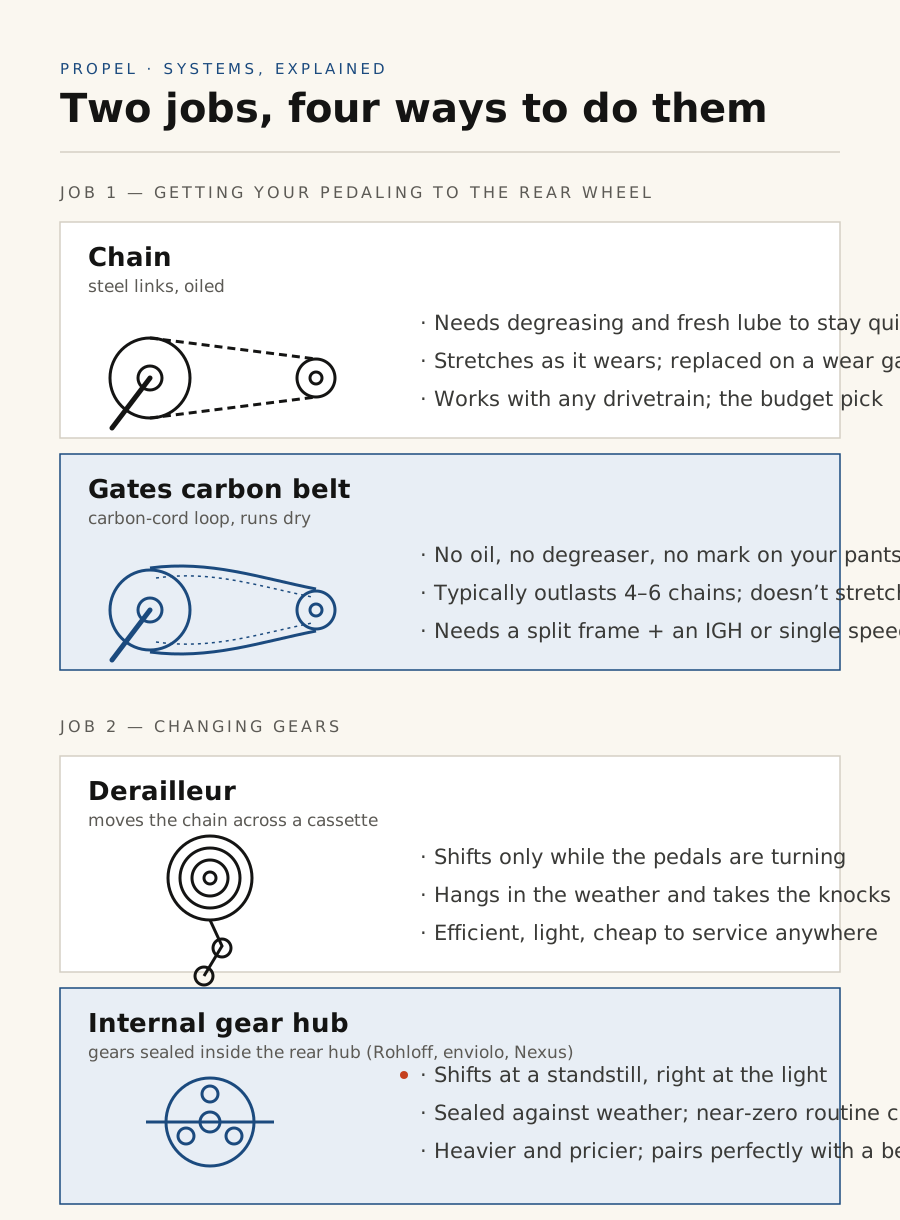
You can't just put a belt on any bike. A belt can't jump between sprockets the way a chain climbs a cassette, so the gears have to live somewhere else, inside an internal gear hub (IGH, a sealed gearbox built into the rear wheel) or a gearbox at the crank. And because a belt is one continuous loop that can't be split and rejoined, the frame needs a small opening at the rear dropout to install it. That's why you choose a belt drive when you buy the bike, because you can't really bolt one on later.
The case for the belt
Gates Carbon Drive makes essentially every belt we sell: a toothed loop with carbon cords inside, from the Denver company that makes automotive timing belts. What it changes about ownership:
- No lubrication, ever. No degreasing ritual, no black chainring tattoo on your calf. Parents notice the first week: the belt side is the side your kid's leg brushes.
- It outlasts chains several times over. A belt typically outlasts 4 to 6 chains. On e-bikes the gap widens, because mid-drive motors multiply pedaling torque and chew through chains faster than legs alone ever did.
- It doesn't stretch. Chains elongate as their pins wear, which is why we gauge them at every tune-up. Belts don't, so there's no shift-quality decay between services.
- It's quiet. There's no chain slap over the Manhattan Bridge expansion joints.
In return, the belt needs correct tension and alignment. Too tight wears bearings, too loose skips teeth under load. We set tension with a gauge at build, and it's a 30-second check at any service. Misalignment, not mileage, kills belts early; one that's jumped a tooth under full cargo load usually gets replaced rather than trusted again. It's the one shop-dependent part of belt ownership, so we check it even when you came in for something else.
The gear question: three ways to lose the derailleur
Rohloff: the buy-it-once answer
The Rohloff Speedhub is a German-made hub with fourteen evenly spaced gears spanning a 526% range, about what a full mountain-bike drivetrain covers, sealed in an oil bath. Routine maintenance is one thing: an oil change every 3,100 mi (5,000 km) or once a year, whichever comes first. For most riders that works out to once a year, and it's quick.
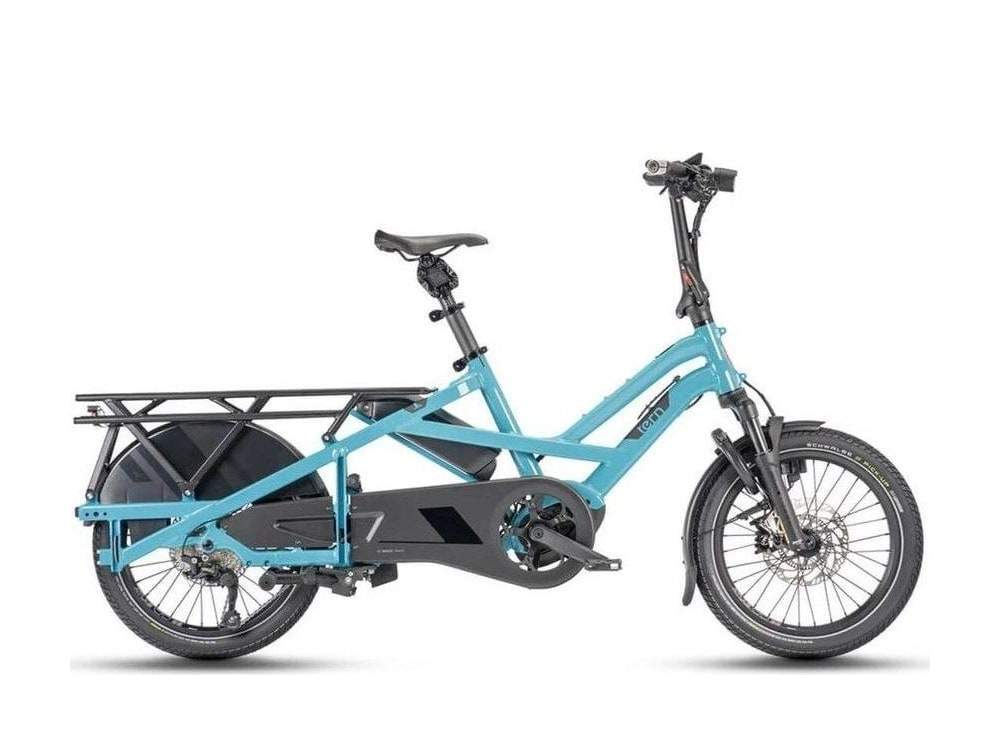
We once converted a customer's R&M Load 60 from an enviolo hub to a Rohloff because his family bikepacking trips needed more gear range (that story is here). That's the Rohloff profile: the rider keeping the bike forever who wants the drivetrain to be a settled question. On current bikes it usually comes with electronic shifting (Rohloff E-14, which shifts with a click from the bar and syncs with the Bosch system); the Tern GSD R14 pairs it with a Gates belt on a cargo platform.
Rohloff adds roughly $1,500 to $2,500 to a build. So you're paying up front for a drivetrain built to last a very long time, and whether that math works really depends on how long you'll keep the bike.
enviolo: the don't-think-about-it answer
enviolo (Dutch, lowercase on purpose, formerly NuVinci) builds a stepless hub: a CVT (continuously variable transmission), with no fixed gears at all. Twist the grip and the ratio slides smoothly anywhere in its range, no clicks, no steps, nothing to mistime. The Automatiq version shifts for you: set a pedaling cadence you like and the hub holds it, like cruise control for your legs.
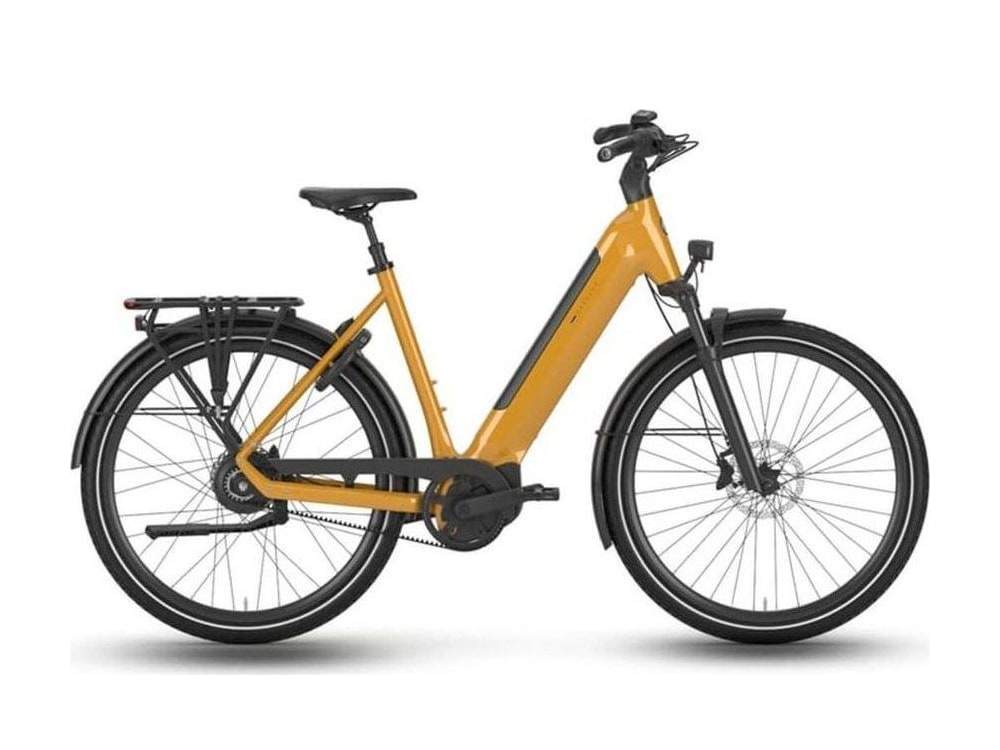
This is the drivetrain we put commuters on when they say "I just want to ride." The Gazelle Ultimate C380 is the archetype: enviolo hub, Gates belt, Bosch motor, nothing to fiddle with. Trade-offs: less total range than a Rohloff (enough for the bridges, tight if you're hauling weight up real hills), and a CVT gives up a little efficiency to friction, which the motor masks until the battery dies.
Shimano Nexus, and a word on Pinion
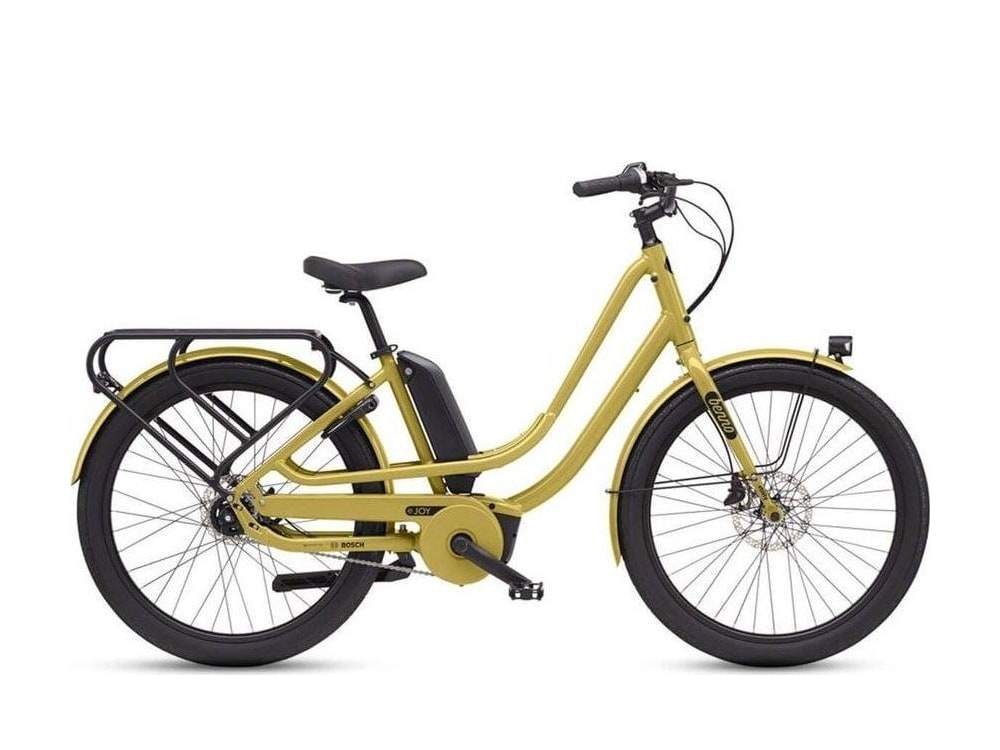
The third path is Shimano's Nexus line of 5-to-8-speed hubs, the budget IGH that's moved millions of Dutch city bikes for decades. You'll find it on the Tern NBD and Benno eJoy, sometimes chain, sometimes belt. Narrower range, very serviceable, sealed and simple at a lower price.
People also ask about Pinion, the German gearbox that sits at the crank instead of the rear hub, including their motor-and-gearbox-in-one MGU. It's really good engineering, but we don't carry a Pinion bike right now. If one earns a place on our floor, you'll read about it here first.
When we still recommend the derailleur
A derailleur drivetrain is lighter, cheaper, more efficient, and fixable with parts from any bike shop in America. That's why we still sell plenty:
- Budget-first buying. Belt-and-IGH hardware adds real cost. The Tern Quick Haul D8 carries a kid and groceries fine with a chain and derailleur, and every dollar saved is a dollar for the child seat and rain gear.
- Sport riding. Drop the bike into a corner on a trail and you want the efficiency and quick ratio changes; the e-MTBs and adventure bikes on our floor stay derailleur for a reason.
- Fix-it-anywhere travel. A bent derailleur hanger is a roadside repair. A hub internal is a warranty case.
The question we ask at the counter: how many miles, how much load, how much do you want to think about it? Daily miles plus cargo plus zero appetite for maintenance points at belt and IGH every time. That's about a third of our floor now.
The maintenance math, from our service team
What a typical year of NYC commuting (about 2,000 mi through winter) asks of each setup:
| Chain + derailleur | Belt + IGH | |
|---|---|---|
| Lubrication | Every couple of weeks in dry weather, more in slush season | None |
| Drivetrain cleaning | Regular degreasing, or shifting suffers | Rinse it with water when you wash the bike |
| Wear replacement | Chains on a gauge; cassette and rings eventually follow | Belt inspection at tune-ups; sprockets wear on belt-length timescales |
| Shift adjustment | Cable stretch + hanger alignment as needed | None (Rohloff) / none (enviolo); E-14 firmware updates ride along with Bosch app updates |
| The one thing to respect | Winter salt | Belt tension + alignment, checked at service |
Neither column is zero. But one is mostly things you (or we) do monthly, and the other is mostly things we glance at twice a year.
To feel the difference, book a test ride: we'll put you on a Gazelle C380 and a derailleur bike back to back on the same streets, and shifting while stopped at the first red light usually settles it. The whole belt-drive lineup lives at /shop/belt-drive.